Showing posts with label stacking. Show all posts

Sunday, September 5, 2010

QRSS Averaging - Redundancy

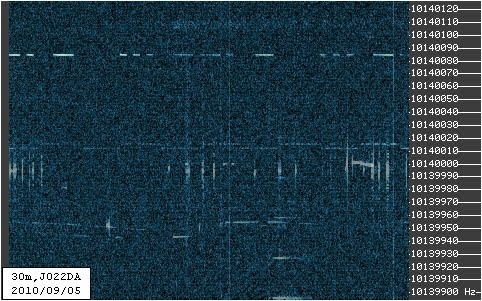
With the help of Alessandro IW3SGT, I was able to collect some interesting data. Alessandro set his transmission so that his ident is sent out twice in a 10min period. Timing was perfect!
Towards the end of the session, strong fading dominated the game, and this is what this entry is about.

The last 30min of the opening look exactly like this

1800z - 1810z
1810z - 1820z
1820z - 1830z

The above spectra never show "SGT" completed. Have a look at the average of those spectra:


Here we go, thanks to the ident being TXed twice in the course of 10min, it is easy to figure out the ident from the averaged spectra.

BTW, adding the frame from just before the above mentioned 30min, result is really obvious...

1750z - 1800z
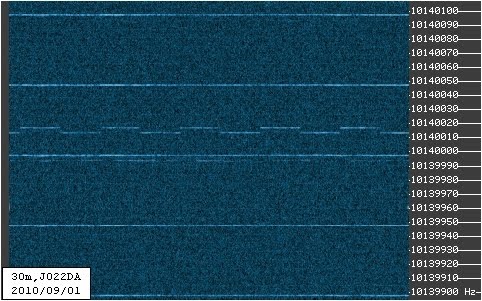
40m average
I am not sure, I remember to have observed a QSB frequency having a period of about 10min, that was on 600m, trying to decode G3ZJO's WSPR. Maybe a 10min averaging is not such a good idea after all, and 5min should be chosen.

Saturday, September 4, 2010

QRSS Averaging vs Plasma TV - 2nd Test

Short update on averaging fighting a plasma TV.

I selected the best and the worst of the 10 frames used for averaging. It seems that every plasma TV has got its own finger-print...

Let's have a look:

best frame

worst frame

average of 10 frames
... using the (old) dark frame
... dark frame and cut "low" pixels
This shows, as long as the local noise is regular enough, one can either simply ignore it, or fight it with simple measures. I think, I could do better on the dark frame story, however, I still lack pure TV signal to create my "plasma frame".


UPDATE
6 frames stacked (no dark frame), positive QRSS identification of "SGT" despite the plasma TV... more to learn. I should make my dark frame soon.
positive identification of SGT

Thursday, September 2, 2010

QRSS Averaging vs Plasma TV

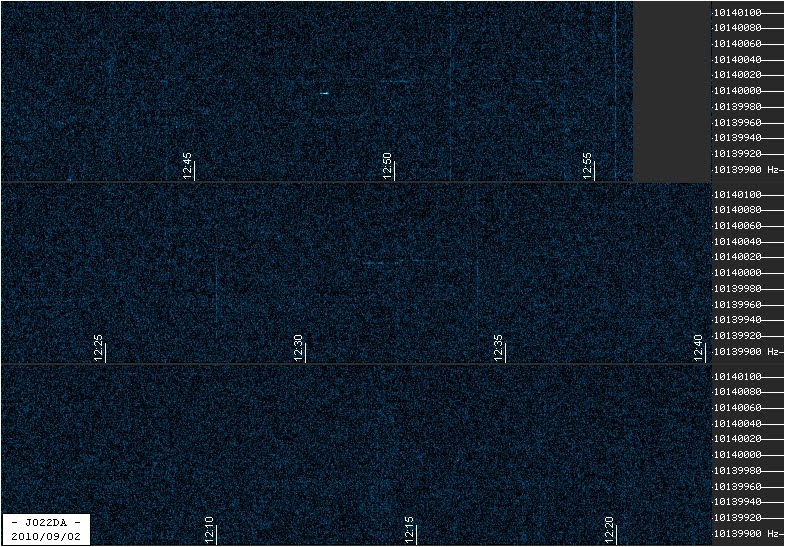
Well, what about those, would you think that any reasonable signal identification can be derived from this? "Ja hoor!"


Raw Data

Feel free to download the images and try for yourself!


Averaged Spectrum

And we can identify Paolo once again ;-)


Dark Frame Technique vs Plasma TV

A plasma TV creates some more or less static lines, like hot pixels in a long exposure CCD camera. The dark frame technique subtracts the "ideal" hot pixel map, or TV lines, in our case. A dark frame is created the same way as the averaged spectum. In the case of a CCD camera, one simply puts the lid on the objective lens. For TV, life is more complicated. To create a dark frame, I selected spectra were the TV lines were essentially the only signals present. Maybe, in a second step, one may want to try to capture spectra of the particular noise source with an insensitive antenna close by...
That would be my dark frame for tonight (5 selected spectra averaged):


With dark fram "opacity" set to 30%, that's what the little averaging program comes up with:


DF opacity set to 100%, pixel values of less than 160 are set to 0.


Dark Frame Technique vs OTHR

Yep, this technique is suitable for getting rid of radar stuff too. To me, it seems more to help aesthetics than anything else... but... you never know.
Last night, nice radar spectra were recorded. A couple of those resulted in the following radar "dark frame":


Earlier today, that was recorded... (averaged)


Averaged using the dark frame:


Conclusion

Those are my first steps using my experience in imaging gather in long-exposure webcam deep sky photography. I am in a very early stage using said techniques in QRSS imaging. My impression is,
imaging techniques used in astrophotography can help QRSS. Those techniques can even help fighting local QRM. A lot more learning is required... I remember my learning curve in astro-stuff... my first astro-images totally sucked!

Daytime Averaging

Unfortunately, the night did not really reveal any good condx. However, during daytime, very poor condx allowed to see some Southern European signals.

During the time span in question, the regular grabber took the following spectra


In the time between 10:30 and 13:00 UTC, 15 10min spectra were taken. Successive 5 of those spectra were average into 3 intermediate results, which were averaged again. Remember the demo-version of the stacking software allows for max. 10 images to be treated.


Averaging Result


Metallic Effect (irfanview)


Paolo's FSK signal nicely spreads over the full 10min span. Due to fading, the signal never made it into JO22 for any continuous 10min, as the 15 "frames" show.

The SNR could be further improved by selecting the best spectra, i.e. with at least some signal. I went for the "blind" method (using all frames) an automatic grabber would perform.

If interested in the raw spectra (frames), drop a comment, I will make a zip-file available for download.

QRSS Image Averaging

First test on 10min QRSS spectra averaging using http://tawbaware.com/imgstack.htm
Thanks to NH7SR, it seem somewhat obvious how to record timed spectra. With good stability and timing assume, image registration seems not to be required. Hence, simple stacking or averaging would be a promising start. Here's some first stuff, not refined yet... a somewhat early pre-alpha stage.


Raw Data

The following 6 images are raw spectra, as recorded and used for the averaging.

Raw
Raw
Raw

Raw

Raw

Raw


Averaging Result

Average


Conclusion

The settings are pretty much same used for the online grabber. For an averaging grabber, more noise, i.e. contrast & brightness, could be tolerated. Data acquisition with more aggressive settings is presently ongoing.
I believe, the first hour, compressed into 10 minutes show a promising start and some potential when the learning curve is surpassed.


Update

Some more spectra are in, as promised, more aggressively set. This is what those look like.

Raw
Raw
Raw
Raw
Average

Sunday, December 13, 2009

Astronomy meets QRSS

Inspired by last nights experiment, I suggest the following:

Let's transmit in predefined time slots, as the IBP-beacons.

This could be used for the following procedure:
  • start a grab a some 10secs before the slot, and end it some 10sec after the slot
  • put the spectrum in a file named after the slot + sequence number
  • register and stack all files of a single slot (as it is done in modern astrophotography)
The question is, how to automatize this. I'll look into this...

Benefits, extreme noise reduction due to integration over a longer period, as done in astronomy. (check my astronomy stuff at www.qsl.net/dl1gsj - webcam imaging with small telescopes).