Friday, August 21, 2020

QO-100 Es'hail-2 ground station

It has been a while since I was busy with a ground station for the geosynchronous (geostationary) satellite Es'hail-2 also known as Qatar Oscar 100 or QO-100.

The major delay in the beginning of the project was to receive an assortment of coax adapters. Finally, those were in, now, the down-link was sorted rather quickly. There was a disused 35cm dish, which I used to analog ASTRA reception. When ASTRA satellites turned digital, I lost interest in watching those, so I never upgraded the equipment. Although, I never dumped any of that stuff either.

So, here was my down-link receiver, PLL-LNB with the old 35cm dish in a FUNcube SDR dongle. That worked perfectly. I later replaced the FUNcube dingle with an SDRplay RSP1A, so that I could receive the entire bandwidth of QO-100's narrow band transponder, allowing for locking on the mid-beacon for frequency stabilization.

Concerning the up-link, I decided to go for a DXpatrol converter. I like the possibility to select the baseband, although, I will probably stick with 432MHz.
To amplify the 2.4GHz signal, I went for the omni-present chinese 8W WiFi-PA.

Then came a long struggle of what to do about the up-link hardware.
Initially, I considered an RHCP helical antenna, something in the realm of 15 to 20 turns.
Then I found a 60cm offset dish in the trash. So, what about a 4 to 6 turn LHCP feeding helix? And yes, I wound that thing. But, the mechanical details of holding the thing in place put me off again.
Finally, I decided on a K3TX LHCP patch feed for the 60cm dish. 
I know, 60cm is rather small for a 13cm wavelengnth... 10 lambda upwards make the deal... I know. However, 60cm is what I got.

The dish I got had not LNB/feed mounting hardware, so this is what I came up with.

K3TZ LHCP patch, PCB over Al

You may wonder what the strange structure to the left is, this will be the mount to the dish.
Something not obvious from the above picture, I am using a F-connector for this feed.
Please note that this picture was taken before I filed down the edges to of the reflector to the circle seen scratched into the aluminium sheet.

The patch feed added to the up-link dish

Winds can be pretty strong over here, so I mounted the dish to a concrete parasol stand.


Up-link (grey) and down-link (white)

Note that both channels are using 75Ohms satellite cable. While for the down-link this is fine, the up-link will experience this as an attenuator, in particular over the length I am using for this experimental setup (about 20m).

Having done some experiments, I could hear my signals in both CW and SSB (USB). While CW was easy, single side band was somewhat challenging. I would not count for any SSB QSO with the attenuator in place.
However, CW should be just fine. Have a look how the signal compares to the lower beacon:

Lower beacon and pa1gsj carrier

This was my first day of bouncing signals from QO-100. I know what I need to do now, i.e. building an outdoors cabinet next to the up-link dish.

I hope to be QRV as an audible station on Es'hail-2 soon.


Update

After further improvements, I can now provide relative signal strengths from my receive setup:

  • transponder noise about 32 dBuV
  • CW beacon 58 dBuV
  • my own signal 41 dBuV
I can also report that I made two CW contacts by now, the lower report was 589. 

Thursday, May 14, 2020

Boom boom pafffff

Something totally off topic today, OK, it's audio, no electronics involved however.

IKEA is known for some interesting projects here and there, beyond the famous bookshelf. Lately, they introduced a product range which appears to be a collection of random stuff, the collection being "FREKVENS". There are even products that could be interesting for a blog concerned with electronics. No worries, I wont be writing about a silver rain coat or a silver cushion cover either.
Let's have a closer look at the only real IKEA flat pack product in the collections, the FREKVENS Cajón (drum).
No, this is not a drum, this is a cajón, and instrument well known in Spanish and Afro-Cuban music. A cajón can create sounds similar to various parts of a drum kit, which is a matter of great skill, which I don't have.
There are a few more things wrong in the product listing, at least what the images are concerned. The side with the big whole is the back-side (or reverse, depending on your style of English). Hence, the guy in the photo sits on it the wrong way. Also, he appears to be slapping the sides of the instrument, which are made of much thicker material and not supposed to be the main playing surface.

Anyways, I bought one of those flat-pack instrument kits and build it according to the provided instructions. BIG mistake! The more I learn about the instrument, the more obvious this should have been.
The assembly instructions take a similar order to something like a nightstand. Which, seen from IKEA's perspective, does make sense. However, when following the leaflet, it is almost inevitable to create a misaligned box  that does not sound right.

Step 1
The instructions start with mounting the snares to the (front of the) bottom-plate, so far so good.

Step 2
The side-walls are screwed to the bottom-plate. This is the first instance where things can go wrong. The alignment of the outer edges of bottom-plate and side-walls needs to be precise. This might not be that important on the bottom-plate, desirable however.

Steps 3 and 4
According to the instructions, the top-plate is now mounted to the side walls, very similar to bookshelves, nightstands,  etc. I cannot emphasize enough, don't do this yet. I did it and I ended up with a slightly misaligned top-plate. This misalignment kills the instrument!

Step 5
In this step, the playing surface, i.e. the front, is mounted. Remember, the front is where the snares are. This is very important for the functioning of the instrument and not clear from the instructions.
This step should be done after step 2, if not before...
If you followed up to now, you will understand that it is important to not tie down any of those screws yet.

Step 6
Here, the back-plate of the cajón is screwed to what we assembled so far. Please note, we skipped steps 3 and 4, so there wont be any (I should have written about that in step 5, sorry!).

Final assembly according to me
If you followed my advice, you skipped steps 3 and 4. What you should have by now should be a square wobbly bucket with no lid.
At this stage, carefully work the top-plate into its position. This might be a bit tricky, therefore, we did not tighten those screws. Once the top-plate is in place, we want to first tighten the screws of the front-plate including the ones we skipped. This will auto-align the top-plate to the side-walls. This alignment is most important to the good functioning of the instrument.
Once this alignment is established, screw down and tighten the 2 front screws on the top and the side-walls.
Now apply all the remaining screws. And tighten all screws on the back and the lower half of the screws on the front.

Tune up
In case of all screws being tight, you will have to hit the cajón very hard to get the snare effect. This will result in an imbalance between the snare and the bass drum sounds.
Therefore, what you are looking for is a small gap between the top-plate and the front-plate. To realize a somewhat even gap to your liking, you have 5 screws in the top half of the front-plate to play with, i.e. loosen and tighten. Every little bit of tension here and there will change the tone and snare sound created by the cajón. It took me a while to balance the right and left corners of the upper playing surface.

Conclusion
IKEA is good in creating wooden flap-pack products. The FREKVENS Cajón is no exception, when built and aligned correctly.
There are competing products available from musical instruments suppliers, here is an example. This example supposedly requires additional materials for assembly, although at a lower price.
What I am concerned, after having aligned my cajón, I am pretty happy with the sounds it can create and look forward to learning this instrument.


Wednesday, April 22, 2020

60m Region 1 Crystal Combination

Sorry for having been silent for so long. There was a lot going on over the last few years.

Anyway, the present situation brought me back to Ham Radio and thinking of building stuff. However, I have to mention that this post should be considered more as a note to myself or inspiration of fellow RF designers, rather than a fully worked out recipe.

The topic of one of my next projects will be building some QRP rig for 60m. Over here in the Netherlands and in Region 1, we got a very small slot from 5351.5kHz to 5366.5kHz assigned as secondary service with a maximum EIRP of 15W. This is a range which appears to me to be almost ideal for building some QRP gear.
In modern times, we could use DDS systems to get us anywhere with anything, I must admit. In the older days, using combinations of readily available inexpensive crystals was the #1 choice for QRP.
Whilst having CW in mind, some of my thoughts my actually be useful for a side-band superhet design.

Here is what I found:

  • 15.360 MHz crystals for use in a VXO (or superVXO)
  • 10.000 MHz crystals and oscillators for BFO and filter stages.
To be honest, I just cooked up the idea and have not thought is through entirely. But here is what my mind came up right away.
As a side remark, subtractively mixing of crystal oscillators is a well known method of eliminating temperature drifts. So, effectively, this could lead to very stable designs, when done properly.

Transmitter
Option A is a canned 10.000MHz oscillator and push the signal through a 10MHz crystal in order to produce a sine wave.
Option B would be a regular crystal controlled discrete beat oscillator.
Mix any of option A or B with a 15.360MHz VXO to generate a 5.360MHz output signal. Should the pull be insufficient (not very likely at 15MHz) one could still use a superVXO.

Receiver
Here is where the concept presently struggles. 
Of course you would think building a crystal filter with inexpensive 10MHz crystals. However, this would probably exclude option A for the TX. Here is where the struggle lies, would it be possible to create a filter design with 10.000MHz crystals that pulls 600 or 800Hz away?
When using option B for the TX, of course, one would add a simple RIT design.

CW
You have seen me writing about two different options. Why bother, you might ask yourself. Well, to me, it is all about simplicity. 
For a mere transmitter, in option A, I might just use a canned 10.000MHz high precision oscillator and key just said oscillator, rather than a buffer stage for CW operations.  Experimentation will have to show how that sounds. In terms of simplicity, this would be pretty neat. Such a TX could be combined with some sort of SDR receiver or maybe a Polyakov direct conversion RX based on a 2.68MHz VFO.
Option B would allow for a fairly regular QRP CW transceiver. Nothing to write home about, however, this will certainly be a more complex design.

SSB
Obviously, option A is no longer available here. However, seen that it is recommended to use USB on the Region 1 assigned 30m band, it would be an obvious measure to use a pulled 10MHz BFO for both RX and TX. However, mind the mirror, we are subtractively mixing here.
Having in mind the upper portion of the 60m band, i.e. the weak signal band from 5366.0 to 5366.5kHz, option A might just come into play again. Mind you, QRSS & Co, don't mind about the sideband too much, as long as the operator knows what she/he is doing.

Over the upcoming days, I will work on a concept/prototype and hopefully will be able to report on some progress soon.


Saturday, June 15, 2019

Portable Stereo Stage

This channel has been silent for some time by now, sorry for that! Will be getting more active in the near future.
While this blog started as a RF only outlet, slowly I drifted to all sort of electronics, including speaker enclosure designs using PVC piping material. Yes, those pipes are still in my living room, connected to a class A tube amplifier and fed by some CD players. While sounding pretty good, this is not really portable per se, although, seen against cement speaker enclosure, this is probably relatively portable.
Travelling back and forth nowadays, I was searching for an alternative.

Lately, I found said alternative. Got a couple of JBL Flip 4 BT speakers. Those are connected to my phone using BT.

Those JBL Flip 4 BT speakers can be used as a pair of stereo speakers. Not having read any instructions, I took me some to to figure out how to actually create that stereo stage. Having tested the setup with different kind of listening, from Vivaldi over Herbie Hancock to Dream Theater, I am deeply impressed!
Seen that the setup is that small and inexpensive that fact that I could not find any flaw in the sound experience tells me that I found my next stereo system.
Although in comparison to my tube class A amplifier, some additional noise is evident.

For aesthetic reasons, I chose both Flip 4s to be black. Of course this makes them a little bit more difficult to setup in the right way. A small sticker indicating which is left and which is right should not be a bit deal however.

If you can live with a little bit of pink noise, a setup of dual JBL Flip 4 speakers is highly recommended.


Sunday, April 8, 2018

PVC Tubes Driven by Tubes

Dear reader,

please accept my apologies for keeping you in suspense over my latest projects for so long. 2017 was a very intense year for me. During said year, I changed my day-jobs twice, so, the radio hobby and the audio hobby had to take a break. Concerning jobs, I believe to have finally found the position of my dreams with a lot a really nice people in the company... I believe I have never been happier before!
Anyway, this is not about life, this is about driving tubes, PVC that is, with tubes, such as in vacuum.

My pipe dreams, as you know, are employing 3W (8Ohms) broadband drivers, which came with a super-cheap set. By now, I am convinced that those drivers were the most valuable part in the entire kit.

In search for a 2 x 3W class A amplifier, I came across a Chinese kit supplier (Douk Audio, cf. ebay), who sells single-ended class A amp kits based on 6N1 and 6P1 tubes. Said kits are comparably inexpensive and, while provide good quality parts, come without a mains-transformer.

My choice of mains transformer fell on a 100W transformer offered by a supplier in the UK, search for "big.daddy!" on ebay.

The combo works as a charm! The amplifier kit seems to be made for my pipe dreams.

As an audio source, I am presently using a professional grade table top DJ CD player by Numark.
In the future I consider to add a passive equalizer / tone control circuit to the setup in order to allow for compensating deficits from compressed digital audio formats. For now, I am pretty pleased with the raw performance from CDs.

Saturday, February 11, 2017

More Pipe Speaker Improvements

The last issue I had with all of my PVC-Voigt-Pipes: resonance of the horn. I read about it, I knew about it... and now, I was bugged by it too.

The solution is very simple: a tripe of cleaning cloth, just below the joint of the driver unit to the horn. The effectiveness of which can be tested by slapping a flat hand on either end of the horn. Without the damping cleaning cloth sound would resonate creating some BOONNNNNG BOONNNNG. With the cloth inserted, this changes to BooB BooB.

BTW, this was effective with the designs I published on this blog.

Saturday, January 21, 2017

Pipe Dreams revamped

My prototype pipes always lacked a certain tonal depth. In the past, I laid that down by the fact that I was using 2" pipes (have a look).
The drivers I was using to that time came from a TV set. While this drivers taught me a lot and enabled some experimenting, which lead to the latter 3" design, which sits in my living room, now in a folded manner.
Strangely, the 3" drivers seem not to be of that much better quality... however, the 3" setup a much butter punch in all aspects.

Willing to further experiment with the PVC prototypes, I ordered a pair of 2" 3W drivers, similar to those.
Yep, those cost next to nothing. They sound surprisingly good when driving my folded "XXL PVC" prototypes.

The question remains if it would be worth to further fold the pipes for improved portability.

Sunday, July 24, 2016

PVC Pipe Dreams updated design (audio)

My PVC Voigt pipe speakers were in heavy use during the last 2 years. My study allows for housing those slim monsters.

Anyway, I found 2 problems with them:

  1. too tall
  2. very directional
So, very easily, since those things are all pipes, I slightly changed the design. Have a look!

modified PVC Voigt pipe design
To reduce the length, I changed the position of the speaker in the T-piece and added an elbow to bend the resonator parallel to the the horn. The above image shows the 2 different designs I posted earlier.

Also, I inverted the orientation of the full range drivers. There are some advantages:
  • the drivers breathe directly into the resonator (similar to the folded TQWT)
  • the direct audio of the driver is less directional
  • the drivers are better protected
As a first observation I would like to mention that treble and bass seem prominently present in the horn, while the mids are emitted by the driver directly.
As a consequence, that could mean that the horn should be above the driver, since the stereo field is determined by high frequencies.
The next step would be to put a wooden box around the T-piece driver part of the design. This way, the contraption can be held upright and all the ugly part would be hidden away nicely.

If it all seems rubbish what I write about PVC plumbing, give it a try yourself. All parts are readily available in your local hardware store. 

Concerning the inverted speakers, I am not yet sure myself. However, for the time being they appear to create a pleasant listening experience.

Sunday, July 12, 2015

The Mobile Shack

Followers of my IT blog already are aware of the fact that I am fitting out a worker's van for camping and other spare time activities.
Over the last years (maybe even decade) I was neglecting my radio hobby. The van is meant to be one of the remedies. It is presently arranged to survive a few days in it, however, the van still lacks radio equipment.


Readily available options are the following:
  • 20m PSK as base gear
  • the 20m Pex-Al-Pex loop
  • fishing-pole elevated dipole
  • 30m PSK for mail
  • TenTec Scout #555 (low power consumption and punchy audio)
  • Icom IC-M710 (even punchier audio) w/ respective auto-tuner
  • Vertex Standard VX-1700
  • PCT-IIe

Further thoughts add digital radio such as D-STAR or DMR. Since I got zero experience in that field, I just started my research. As appealing the digital world is, as confusing it is!


Presently, I am somewhat sure about the computing device I will use:
  • HP Stylistic ST4120
  • respective docking station
  • respective 12V power supply

This thing presently runs WinXP.  Years ago, I bought this thing (used) to be the board computer of my sailing boat. For unknown reasons, the PC never made it aboard.


Things I need to do before getting serious with radio in the van:
  • install one or more service batteries
  • install a charger for the service batteries
  • install a VHF/UHF antenna
  • solar panels?
  • create an RF-ground device 

The van also needs a decent WiFi solution. I presently research the possibilities.

BTW, the van is a Mercedes-Benz Vito (2008). Some told me that Vito's are supposed to be like regular cars. Well, driving one, I can tell you that the allover feel of a Vito is more like driving a semi than a people carrier.

73 for now, stay tuned....

Wednesday, April 2, 2014

Finally: The PEx/Al/PEx Loop!

Yeah, that was a good one today. I took a couple of hours for tinkering and finally got to build my long planned magnetic loop aerial made from the recently discovered light weight copper substitute PEx/Al/PEx.

As previously mentioned, RG213 snug fits into the tubing material. This gave me the idea to actually slide in the coax cable in order to form a Galvanically isolated capacitor. Two reasons not wanting connect anything electrically to the aluminum: 1) it is nearly impossible to solder and 2) it will corrode in rapid rate.

As a result, the coax needs to be inserted in both open end of the loop, thereby closing the same capacitively. In principle this is like any other magnetic loop using a butterfly capacitor.
Just to remind you, this means that 2 capacitors are in series, i.e. they don't add up their capacities, they do this instead:
with Cr being the right capacitor and Cl the left capacitor.

There is a second benefit from series capacitors (in magnetic loops), they act a voltage dividers, thereby increasing the sparkling maximum voltage, allowing for higher power, in particular in the case of magnetic loop aerials.

Back to the capacitance story: the butterfly capacitor symmetrical, i.e. both capacitor have the same capacitance. What if the use variable capacitors having different capacitances?
Lets go through this with an example:
Assume that:
Cr = 10pF
Cl = 100pF
What will be the change in 1pF on either capacitor on the resulting capacitance?
  • no change: (10*100)/(10+100) = 1000/110 = 9.091
  • Cl lowered by 1pF: (10*99)/(10+99) = 990/109 = 9.083
  • Cr lowered by 1pF: (9*100)/(9+100) = 900/109 = 8.257
Very obviously changing the higher capacitance has less influence than changing the lower capacitance.

And this is a fact I make use of in my most recent design: a magnetic loop aerial with an asymmetric series of capacitors.

Pictures say more than words:

Fig.1: asymmetric series of capacitors (purple) terminating a magnetic loop

Pic.1: real life look of the terminating capacitance
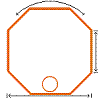
Fig.2: Dimensions used for the 20m band, blueish stuff being RG213

Pic.2: this is more than half a meter of RG213 dangling out the loop
Speaking of dimensions (finally), I need to add that the loop conductor itself is made from precisely 4m of 14x2 PEx/Al/PEx (out diameter 14mm, wall thickness 2mm).

Of course, a magnetic loop aerial needs a primary loop:
Pic.3: primary loop
Dimensions for the primary have a thumb rule: 1/6 diameter of the radiator when placed very far from objects, 1/5 in average situations and 1/4 when used in doors. Mine is made from 80cm of copper installation wire, i.e. 1/5 diameter of the radiator. Of course is very easily exchanged when going indoors.


Why are those dimensions selected?
As to the loop diameter, having a loop with a generic resonance not much above the future operating frequency allow for small capacitance values to terminate (tune) the loop. Having a low terminating capacitance lower the voltage across the capacitor and broadens the bandwidth of the loop.
The length of 4m of said material, when bent into a circle, deliver a natural resonance at about 15.5MHz. Starting from there, very little capacitance is required to resonate the loop at 14MHz.
The 70cm for the length of the "insert" were a lucky scientific a precise guestimate...

How to tune this loop and why is it asymmetric in capacitance?
Both these question seem unrelated, but they are not! The beauty of this entire design is found in asymmetry actually. Remember the section about changing the larger or smaller capacitors in a series of capacitors? The shorter end of the coax (when inserted into the tubing) acts like a "band set", the longer end like a "fine tune".
Inserting the coax entirely in a symmetrical fashion, the resonance drops to close to 9MHz, tuning here is very fiddly...
Having the coax in asymmetric configuration, the longer end provides relatively smooth tuning.

What is the bandwidth?
Well, I have not yet tested the aerial decently, but, first measurements with an MFJ-269Pro indicated that the loop, tuned to 14.060MHz is good for +/- 20kHz.
Certainly there are ways to calculate the bandwidth, the radiator 12mm has a circumference of 4m. There must be some web-application to evaluate such a loop (http://www.66pacific.com/calculators/small_tx_loop_calc.aspx) indicating a bandwidth of about 40kHz... (see below).

My plans for the loop are: QRP and PSK on 20m. Hence, I taped down the short end, as to have my band set. Of course, WSPR and QRSS are also in the reach of this loop...
This loop still is in experimental stage. For a more permanent solution, I will install an electrical box over the terminating capacitor, as to prevent water to collect within the tubing. For the same reason I may even drill a small hole into the bottom of the loop, allowing for drainage.

Concerning the dimensions of such a loop, 30m may still be an option. However, I rather see myself building this loop for the higher bands in the near future.


Results from 66pacific.com:

RESULTS:
Antenna efficiency: 68% (-1.7 dB below 100%)
Antenna bandwidth: 40.3 kHz
Tuning Capacitance: 50 pF

Capacitor voltage: 631 volts RMS
Resonant circulating current: 2.77 A
Radiation resistance: 0.223 ohms
Loss Resistance: 0.104 ohms
Inductance: 2.58 microhenrys
Inductive Reactance: 228 ohms
Quality Factor (Q): 349
Distributed capacity: 11 pF

Antenna "circumference": 4 meters

Loop antenna Side length: 0.500 meters
Antenna diameter: 1.2 meters

Comments:
The specified conductor length of 4 meters is OK.

Conductor length should be between 2.59 and 5.17 meters at the specified frequency of 14.06 MHz.

For highest efficiency, the conductor length for a small transmitting loop antenna should be greater than 1/8 wavelength (greater than about 2.59 meters at the specified frequency of 14.06 MHz).

To avoid self-resonance, the conductor length for a small transmitting loop antenna should be less than 1/4 wavelength (less than about 5.17 meters at the specified frequency of 14.06 MHz).


Input Values:
Length of conductor: 4 meters
Diameter of conductor: 1.2 centimeters
Frequency: 14.06 MHz
Transmitter power: 5 watts